Hi, class I wish you all a Happy Solstice, a Good Yule, a belated Happy Hanukkah, a Merry Christmas, and a Blessed Kwanzaa, and a very safe, healthy, and happy New Year.
It has been a pleasure to learn and grow with all of you.
For my final project, I decided to put my own spin on Urban Dictionary – specifically, an academic, humanistic, DH-centered spin. I proposed a Dictionary Academicus, an academic Urban Dictionary that is also a platform for debate, as well as a ledger of new concepts and terms in DH.
New academic terms, phrases, and concepts are continually being introduced to the literature and canon of Digital Humanities. Often, this influx of jargon can be overwhelming to newcomers to the field, and those in adjacent academic fields. The Dictionary Academicus can change this. In its capacity as an interactive glossary of terms, it has great potential for educating new students and creating consensus amongst the DH community. The Dictionary Academicus can also serve as a platform for debate amongst scholars of DH and related fields.
Caitlin Cacciatore
The Dictionary Academicus is intended to be scalable, and has the potential to expand into other humanistic fields and the other social sciences.
Just as a pearl begins with a single grain of sand, I see the Dictionary Academicus as a scalable website and platform for discourse. It has the potential to expand into other humanistic fields, such as anthropology, sociology, literary studies, history, and philosophy. The possibilities are limited only by the capacity of the human imagination and ability to record, examine, and analyze the facets of life and of culture. In a similar vein to how the Urban Dictionary made common vernacular accessible and immediate to its audience, so too can Dictionary Academicus accelerate the rate at which new concepts, ideas, and turns of phrase trickle into the academic lexicon we share as scholars of the Digital Humanities and adjacent fields.
Caitlin Cacciatore
Ultimately, my project was inspired by the reading we did this semester, and the new terms, concepts, ideas, and turns of phrase I found myself grappling with. At some point in the semester, Professor Gold suggested during a class session that we keep our own Excel document of the ideas we’ve encountered throughout the semester, and that we come across in graduate school. His words stuck with me, and while I was ruminating on the expansion of the English language, the idea of the Dictionary Academicus came to me.
I immensely enjoyed the process of fleshing out the idea of an academic Urban Dictionary, from the original seed of the idea to the seedling it has grown into.
I look forward to working with you all next semester. May your season be merry and bright.
Sara Teasdale is a name many both in the literary world and in the larger sphere of academia would recognize. I have long been fascinated by her works, and as a youth, I had “Barter” printed out on computer paper and pasted on my bedroom wall.
Teasdale was born in 1884, and would go on to write several books of poetry for which she would achieve international acclaim. She won the first-ever Columbia Poetry Prize, now known as the Pulitzer Prize for Poetry, in 1918 for the collection of poetry entitled Love Songs.
“Although later critics and scholars have marginalized or excluded Teasdale from canons of early 20th century American verse, she was popular in her lifetime with both the public and critics.”
The Poetry Foundation
I was able to find four of the seven books of poetry she published in her life on Project Gutenberg:
Helen of Troy and Other Poems (1911)
Rivers to the Sea (1915)
Love Songs (1917)
Flame and Shadow (1920)
Her later books were not available, as the copyright has yet to expire on Dark of the Moon (1926) and Stars To-Night (1930). (On January 1st of 2021, all books from 1925 entered the public domain, so one need just wait a scant few months for the copyright to expire on Dark of the Moon!)
“In the twenty-first century Teasdale has received attention from scholars such as Melissa Girard, who argues that aspects of Teasdale’s poetry have been neglected or overlooked, including her anti-war poetry from World War I.”
The Poetry Foundation
Teasdale’s life was tragically cut short by suicide in 1933. She was just 48 years old. Strange Victory was the last of Teasdale’s books, published posthumously later that year.
For this project, I assembled the four books of her poetry that were available at Project Gutenberg. The final document was nearly 200 pages long.
This exploration into the early years of Sara Teasdale does not document Teasdale’s troubled years, plagued by mental illness in a time where great stigma was attached to such ailments. We will see, in our analysis, a young, vibrant poetess, with great potential and greater passion. While this analysis is, by nature, incomplete, and does not reveal the same nuances a close reading of her works might, it highlights over-arching themes and brings the text to light and to life in a way that would be impossible without Voyant.
That is, perhaps, the incredible power of text-mining and text analysis – when you cannot see the forest for the trees, Voyant and similar tools can provide you with a trail guide – a way to navigate, and a different way of seeing.
Analysis:
‘Love’ is Teasdale’s primary focus, with 349 occurrences throughout her work. Love is described in various turns of phrases, like:
“After love…” which occurs 8 times
“Buried love…” which occurs 4 times
“Hidden/hiding love…” which occurs 3 times
“New love…” which occurs 6 times
Second on Teasdale’s list of literary focuses is the ‘night,’ which occurs 193 times. This contrast – the light of love, and the dark of night – is a poignant one. The strength and power of love dwarfs night, which is described at various occasions in phrases such as:
“Winter night…” which occurs 7 times
“June night…” which occurs twice
“Blue night…” which occurs twice
The ‘sea’ is a word that occurs 164 times, described variously as a “burnished sea,” “darkened sea,” “dreaming sea,” “living sea,” “molten sea” “predestined sea,” “shallow sea,” and “starlike sea,” among others. The shifting moods of the sea are well-documented; the sea is, at some points, “sweet” and at other times “bitter.”
The word ‘like’ appears often as well, clocking in at 166 usages. This is, upon further inspection, is due to Teasdale’s extensive use of simile, which she uses to describe “music like a curve of gold,” in my personal favorite poem of hers, “Barter.”
Rounding out the top five is the word ‘heart.’ You can see the first five of 150 usages in the screenshot below, which gives the context surrounding each usage of ‘heart.’
Also popular were:
Oh (144 usages)
Shall (130 usages)
Wind (115 usages)
Eyes (111 usages)
Come (99 usages)
Song (89 usages)
Stars (87 usages)
Light ( 78 usages)
Soul (65 usages)
White (64 usages)
Rain (60 usages)
Death (53 usages)
Further Exploration:
I decided to play with Voyant’s suite of tools, and made the following graph of the four most popular terms in Teasdale’s early poetry. The graph moves along the horizontal x-axis in terms of document’s segments. For clarity’s sake, I changed the default setting of 10 settings to 12, after experimenting with splitting the book into its original four segments, which didn’t quite shed the same light on the progression of Teasdale’s thoughts and ideas throughout her early poetry. In the graph below, each of the four books are represented by three distinct segments:
Graph of the top four words used by Teasdale
One can see the presence of love in Teasdale’s writing often spiked or dropped, and it would be interesting (though potentially intrusive) to map this onto a history of her personal relationships.
One can see other correlations in the data as well, and it is evident that love is most often Teasdale’s focus, eclipsing all other words in all but a few of the segments.
Another interesting tool is TermsBerry. When one hovers over a word, such as ‘love,’ it appears in green and all related words that appear in conjunction with that word are highlighted in shades of pink, depending on how often they appear in concert with the selected word.
Concluding Remarks:
Exploring Voyant was an interesting voyage. I began with the most basic functionalities, then worked my way to fiddling with the higher-level settings of more advanced tools.
One aspect of textual analysis I feel compelled to note is that using Voyant for text-mining is not necessarily a replacement for reading the text itself. A lot is lost through distant reading – though there is still a lot to be gained through the process. However, one will never be able to feel what Teasdale meant for us to feel, if we use Voyant or a similar such tool instead of reading her work, in its original form; perhaps even aloud, the way poetry was meant to be read.
Yes, certain themes become more evident by employing text-mining, but even though we can safely classify Teasdale’s work as ‘love poetry,’ just knowing that love appears 349 is not enough. It’s an impersonal metric. For a fuller, more complete, more nuanced understanding of the work, Teasdale should be read, either silently or aloud, in conjunction with text-mining.
Only when the tools within us and the tools we create are used in tandem can we fully begin to understand a text we are analyzing.
I will leave you with a poem. It’s an old favorite of mine, and I hope it’ll speak to you too.
The session opened with a brief poll on the participants’ prior experience with Audacity, and what we hoped to get out of the session. I had no prior experience, and I selected that I was interested in editing audiobooks, as that was the only of the poll options that appealed to me. I am a published author and might one day wish to turn my poetry or my (as of yet unpublished) novels into audiobooks.
The instructor, Chelsea Lane, was lovely. She introduced herself, drawing attention to the harp behind her, and then she described the Graduate Center Digital Initiatives (GCDI) and their mission to create and foster a thriving digital community of creators and scholars at the GC.
We first delved into an introduction of Audacity, which is free and open-source audio recording and editing software. It is available on a variety of platforms, including Mac OS, PC, and Linux.
One of the downfalls of using Audacity is that one must record in a quiet environment free of disruption. Before recording, the user needs to set up microphones in a particular way so as to capture the best quality of sound, and check their levels to make sure they aren’t speaking too loudly or too softly.
We were taught how to use the ‘Clip Fix’ tool in the case that the sound is too loud, and the waveform approaches the volume limit. It’s possible this can occur when you speak too close to the microphone.
We also learned that sound quality can be compromised by this effect, an interesting dilemma our colleague Felicity noted. Chelsea’s response to this question was enlightening; she told us that this is part of why it’s so important to come to Audacity with a good sound set-up and high-quality audio, as each additional effect further compromises original sound quality.
We were taught to leave several seconds of silence at the beginning and end of each clip, which enables Audacity to get a sound profile of the room in order to aid with sound editing.
The Noise Reduction tool can be used to reduce background noise, through creating a noise profile with the space of silence you should leave at the beginning and the end, and then reducing that specific type of noise throughout the audio clip. This is useful in the case that the user doesn’t have an expensive, top-quality sound system.
We were then given about ten minutes to play with Audacity and reduce background noise. I read a few poems from Leonardas Andriekus’ “Eternal Dream,” one of the two chapbooks of his that were translated into English from the original Lithuanian.
I volunteered to share my reading of a short poem of his, called “Seven Rivers.”
Seven Rivers by Leonardas Anriekus – Read by Caitlin Cacciatore
We then spoke about splicing, and Chelsea played us an enchanting harp piece, which was quite captivating. I am a big fan of harp music, and hearing and seeing her play, even though it was not in person, was a wonderful experience. I must confess – I got utterly lost in the music.
We also discussed fade-in’s and fade-out’s, and how to create a more natural ending that is less abrupt on the ears with a fade-out, or to create a gentle introduction with a fade-in.
We then moved on to the benefits of adding reverb, which can make music sound like it was played in a larger space, and lends the audio an almost ethereal tone.
We learned that we should copy files when importing them, rather than reading directly from the file, which is also given as a choice in Audacity, as you might run the risk of altering or ruining the original files if you read directly instead of copying.
Finally, we were given some time to play around with some free music and audio files in order to create our own mock podcasts, using the tools we’d learned.
Reflecting on what I learned, I feel much better equipped to edit audio files, remove background noise, create fade-in and fade-out effects, and more.
The world of commerce and business is one with billions, if not trillions, of small, individual, interconnected, ‘moving parts.’ I consider every factory, each company, everything they produce, mine, manufacture, source, and sell to be a moving part. All of these moving parts require people to do the work of planting the seed that will become a crop to be harvested, processed, and shipped around the world by other laborers. Often, the supply chain does not end there, and grocery store employees will keep inventory of this particular food, shelve it, scan it when it is sold, and replace it when it runs low.
In an ideal world, each and every laborer at every stage of the supply chain would be paid a fair, living wage. However, this is rarely the case. The CEO of Starbucks has a staggering net worth of $5.7 billion, while workers can expect to make minimum wage of 15 dollars an hour in NYC, while that number drops to 10 dollars an hour in Texas, which is, admittedly, slightly above Texas’s minimum wage of $7.25 an hour.
The farmer who planted the seeds and did the work of tending them, watering them, and harvesting them, can expect to be paid even less, according to an article from GreenBiz:
“In 2012, Starbucks reported its average price for green beans was $2.56 per pound. However, that is the price it paid to the broker, not to the farmer. After backing out shipping, insurance, importer and exporter and mill costs, that price would be closer to $2.20 paid per pound to the farmer. By 2014, Starbucks was only paying $1.72 to the broker (maybe $1.36 to the farmer). By paying the lower amount, Starbucks took $387 million out of the farmers’ pockets. As green prices keep falling, Starbucks has continued to pay coffee farmers less, while charging consumers more.” – Dean Cycon
This is, perhaps, one of the greatest ethical concerns surrounding modern commerce, consumerism, and capitalism – that those at the very bottom of the supply chain, often working in the Global South and suffering from extreme poverty, make pennies on the dollar, while the CEO lines his pocket at the expense of the farmers, the factory workers, the delivery truck drivers, the minimum-wage laborers, the environment, and the consumer. This dichotomy is discussed at length in Posner’s “See No Evil.”
In “Capacity Through Care,” Nowviskie suggests that feminist ethics and thought are, perhaps, part of the solution. She says, “A feminist ethic of care seeks instead to illuminate the relationships of small components, one to another, within great systems—just as many platforms for large-scale visualization and analysis and scholars’ research agendas do.” This feminist ethics of care is a tool we can use to expose what is in “the black box” and shed light on unfair, unjust practices.
In the words of Audre Lorde, “the master’s tools will never dismantle the master’s house. They may allow us to temporarily beat him at his own game, but they will never enable us to bring about genuine change.” We need new tools, such as feminist ethics and praxis, to start to tease apart the oppressive patriarchal framework that keeps so many people trapped in poverty and empowers the cisgender, heterosexual, able-bodied, white male of European descent above all other groups.
As Ernesto Oroza puts it, “renewed answers will always come from the resistance.”
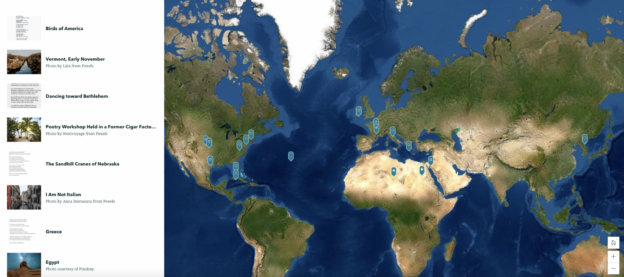
Mappamundi opens with an excerpt of Collins’ poem, before going on to explain the inspiration behind this project, which maps nineteen Billy Collins poem titles containing geographical references onto a map of the world.
For this project, I scoured the web for Billy Collins’ work. I tried to find a complete bibliography of his works that would include titles of each poem, but was unable to do so. I first visited the Poetry Foundation for an extensive list of his publicly available poems, then I browsed Amazon and looked through the free previews, which thankfully included tables of contents with the names of each poem contained therein.
After gathering the names with geographical references to various places, I set about placing them on a map of the world. From this, I was able to understand and visualize Collins’ Mediterranean and rural American influences.
In the interest of full disclosure, I am not entirely certain that I have managed to find each and every last Billy Collins poem with a geographical references, so this map may not be complete. There are, however, enough data points to discern recognizable patterns.
You will find more information on my methods, and on Billy Collins himself, by visiting my project page.
If I’ve missed your favorite Billy Collins poem, let me know!
Maps have long been used to stake claims to territories and to define the boundaries of empires. In today’s increasingly digitalized world, the map is no longer a static, unchanging, two-dimensional sheet of paper, but rather a dynamic, three-dimensional tool that can be updated instantly and accessed anywhere with Internet connectivity. However, this quality does not make the modern map infallible. Indeed, in addition to their primary function as a navigational tool, mapping platforms also serve as a way of illuminating historical inequities and the growing divide between the Global North and the Global South.
In “Dividing Lines: Mapping platforms like Google Earth have the legacies of colonialism programmed into them,” Mayukh Sen makes the argument that “Google Earth reflects the scars of colonial legacies and has tended to reproduce colonial fractures and reinforce that era’s lasting wounds.” He details how certain nations and towns can be zoomed into in full, vibrant color, while zooming in on others results in unrecognizable shades of grey or beige. This perpetuates the harmful colonialist idea that “some people’s homes are more important than others.”
Maps can also serve as a form of control. As Yarimar and Hantel put it:
“Cartography plays a constitutive role in this process, as it has historically reproduced the idea of the sovereign nation-state as a bounded entity and naturalized it as the site of proper politics. Geographic histories reveal that the visualizing power of the map preceded the formation of sovereign states and created the conditions of possibility for colonial expansion. As Jordan Branch argues, maps reshaped our perceptions of legitimate political authority and organization, paving the way for the shift from medieval to modern political structures.”
It is impossible to separate map-making from imperial methods of exerting control and dominance over territorial holdings and colonies. The production and proliferation of maps has historically been used to extend the long hand of empire, with European powers dividing whole continents and swathes of land as a means of conquest, regardless of the lasting repercussions of such divisions. In one instance given, “hastily drawn borders” drawn arbitrarily “over the course of two days… would echo for decades.” (Sen) This would uproot in excess of fifteen million individuals, and result in over two million casualties.
This so-called Radcliffe Line, named after the British judge who drew it, separated a British-ruled India into the independent nations of India and Pakistan. According to the BBC, which is, perhaps, a biased source in this particular instance, Cyril Radcliffe was given “five weeks” to draw this line. The BBC also underestimates the displacement figures by three million, and gives the number of the dead as anywhere between “half a million and a million.”
For his efforts, Radcliffe was given a Knight Grand Cross of the Order of the British Empire. Also of interest is the fact that he burnt all of his notes before departing India, raising the question of what, exactly, he had to hide.
Works Cited:
Bonilla, Yarimar, and Max Hantel. 2016. “Visualizing Sovereignty” Sx Archipelagos, no. 1 (May).
“Cyril Radcliffe: The Man Who Drew the Partition Line.” BBC News, 1 Aug. 2017, www.bbc.com/news/av/world-asia-40788079.
If I were to center an understanding of Digital Humanities (DH) upon the sites and projects provided, I would likely define DH as a field that produces humanities-based projects using technological and digital means, such as website-building, data analysis and visualization, and mapping. Further elaboration of the field would specify that it is used in order to highlight a fundamental issue in society or culture, draw connections between various historical events, illuminate and reflect upon the past, and educate people in the present so that they may become better citizens of tomorrow. Any such definition would also include that DH does so in such a way as to be freely accessible to anyone with an internet connection, thereby democratizing the field and its findings.
If I only had access to one such site, I might define the Digital Humanities differently. A definition based on “Torn Apart / Separados” might focus more heavily on mapping and data visualization, and would likely tend to skew towards the political and immediate ramifications of the data set, rather than a more historical, reflective viewpoint, such as the one displayed in “The Early Caribbean Digital Archive.”
My definitions would differ in the scale and scope of Digital Humanities as well, as one focuses on the relatively recent past and the immediate harm and trauma caused by ICE policies and raids, while the other is centered more on the past, and the lingering effects of colonialism, imperialism, the enslavement of indigenous peoples and African chattel slavery, as well as the systems, institutions, legislation, etc. borne of this era, or that can trace their roots directly or indirectly to the imperial consciousness.
In truth, DH is all of these things and more. DH cannot be defined by any single project, because it is a field where the conversation and dialogue between academics and their works are as important as the work itself. In “Digital Humanities: The Expanded Field,” Klein and Gold argue that the conception of “the expanded field is constructed by the relationships among key concepts, rather than by a single umbrella term. And it is by exploring these relations—their tensions as well as their alignments—that the specific contributions of the range of forms and practices encompassed by the field can be brought to light.”
Any definition of Digital Humanities will doubtlessly be refined and redefined as time passes, as the field evolves along with technological progress and new forms of media. For now, defining DH is a worthy endeavor, but is a journey that should be embarked upon with the knowledge that any working definition is a work in progress. As digital humanists, it is our duty to redefine the borders of our field in order to be as inclusive as possible. It is this continual reinvention, refinement, and re-envisioning that will come to characterize this particular field of study.
Need help with the Commons?
Email us at [email protected] so we can respond to your questions and requests. Please email from your CUNY email address if possible. Or visit our help site for more information: